mercredi 29 septembre 2010

KOMINTERN: PART TWO

vol. 3, no. 8, October 1-15, 2010

Si vous voulez lire en français: http://www.laviereelle.blogspot.com/

You will find below the link to L'Humanité in English, a selection of articles from the daily communist paper published in Paris (France).
WE ALL CAN DO SOMETHING
Everybody should read Northstar Compass. It is the magazine of the International Council for Friendship and Solidarity with Soviet People. Yes, Soviet people; and it is published, especially now in the years 2000. Recently, there was a striking document written by the Socialist Party of Bangladesh.

Their first stand: “the conduction of powerful political struggle who will be able to bring back the confidence of common people towards revolution, people and Marxism-Leninism, and will be able to fulfill the aspirations of mass emancipation of millions of martyrs”. This last word is too strong, mind you; let’s see how it is even more relevant today!
(Photo General Consulate of Cuba in Montréal: the future of their homeland and abroad, the young pioneers)

They deal with the need “to fight out individualism”; they stress too that “we are still in the era of imperialism described by Lenin”, providing examples: “in Britain, industry, health and service sector which developed on government’s initiatives were privatized, which means that British government commenced privatization. In the United States there is no such scope of privatization since even military sector in U.S. was also under corporate capital”. They point out that the “bourgeois” media want the workers to swallow all these setbacks, like gullible children and even... demand more. They don’t refer only to rich nations. For instance, they affirm that “the annual income of only one corporate organization like General Motors exceeds the total income level of a country like Bangladesh”.
These same rich countries contribute to the development of their agriculture. “The total amount of subsidy equalize more than the defence expenditure of many countries.” But they react promptly to any opposition. “They attempted to destroy Cuba, the source of anti-imperialist struggle of Latin America; there is ceaseless attempt from U.S. to assassinate Fidel even.”
As they say, “this has brought into light the acute depression prevailing in the society.”
Shylock, in The Merchant of Venice, the masterpiece of Shakespeare, would be more than at ease with this statement: capitalism, “side by side increased the periphery of usury”; and “loan driven economy was created”.
We are living in a planned economy of unemployment, poverty and competition; the so-called “market economy”, or the “bubble economy”. But, “all these phenomena demonstrate the vulnerability of imperialist-capitalist economy”.
The plain truth? In USA alone, “70 million people are living below poverty level; 13, 7 million in the month of April of 2009” became unemployed.
(Photo: McDonald's, the fast-food empire of low-waged young workers)

The answer

Edward A. Drummond, a US communist writer, in a recent writing, confesses sadly that: “Prompt Press, a printing press that has traditionally printed the Party’s newspaper and pamphlets, is on its way out. The Party (Communist Party USA, Ed.) Archives were given away for free four years ago to a wealthy private university. There has been no Party candidacy for any public office in perhaps 15 years. There are no bookstores. There are few or no pamphlets.
There are no mass public meetings –even by today’s modest definition of “mass”- and no attempt to organize them. There is no mass distribution of the Party paper. There is no industrial concentration policy.” Drummond adds up that: “Moreover, in tailing Obama, the CPUSA is ignoring its own 2005 Program, which states: ‘U.S. capitalism is presently in the monopoly capitalist, imperialist stage of development, and in the transnational monopoly phase of that stage. Once the most reactionary ultra-right transnationals, who dominate political life today, receive a major defeat, it will be both necessary and possible to take on the transnationals as a whole; it will be possible to move on to the anti-monopoly stage of struggle.”
The Cuban Five
On the other hand, you have the courageous Cuban Five – jailed in USA- and actually serving heavy sentences on false charges, fighting with determination the indifference and silence surrounding them in North America. Antonio Guerrero, -one of them -, poet and close friend wrote to us saying: “Finally, on May 3rd, I was transferred from the penitentiary to a medium-security prison. The travel was short. [...] The change is great. [...] Another big impression has been the almost total absence of that tension that exists in penitentiary life. I can see that prisoners here are more quiet and polite, and the noise is low. Of course, it is still a prison, but everybody tries to avoid any incident and to maintain a good conduct.” The Five have been scattered in different prisons practically from Day One and ever since more than 11 years after.
Antonio’s poetry calls upon us: “So much encouragement, faithful friend! You give me your faith and your song to answer each enemy blow.”
They have friends all around the world, be it in Canada, in Lebanon, in Spain or in France to name just a few. President Obama must free them and restore their dignity; he has the power to do so.
In February 2010, the newspaper of the Communist Party of Australia, The Guardian, published a letter to Obama which states: “ Each year the majority of UN member states has supported Cuba against the blockade and each year the vote has increased in Cuba’s favour, clearly indicating that public opinion is growing worldwide for an end to your genocidal policy. “ It was signed by the president of the Australia-Cuba Friendship Society, Joan Coxsedge.
Towards a new Komintern?
In April 2010, The New Worker, weekly paper of the New Communist Party of Britain, underlined in its editorial: “The real answer for workers is to fight back and to do this effectively we must join together, recognize that the ruling class is our enemy and fight in the short term to keep the Tories out. And then to force Labour to deliver better policies for the working class so that we can live decent, relaxed and enjoyable lives. But in the long-term we must fight together to get rid of the whole rotten capitalist system and replace it with socialism.”
This is not an impossible dream. Already in 1935, 18 years after the Russian revolution, the great American singer, Paul Roberson, went to Soviet Union. The Daily Worker, at that time, collected his impressions and words: “He has deliberately and for a long time been laying plans and preparing to move to the U.S.S.R. as the most suitable center for the important work of artistic innovation which he has in mind, and because he had decided on the basis of much evidence that it is a place where a man may do such work with greatest freedom and facility. He said in his interview that he is more than satisfied that the Soviet Union is just such a place.”
In the meanwhile, we may follow the people’s and workers struggles, for instance in Greece; we don’t know the outcome yet, we may conclude with the Socialist Party of Bangladesh: “Communist parties of different countries in the world, at sub-regional, regional and international level should conduct regular criticism-self criticism to eliminate the differences in opinion by ideological struggle and to develop monolithic communist international.” Komintern is the contraction of two words: Communist and International. The communists from the People’s Republic of Bangladesh share this viewpoint with many communists around the world. The Communist Party of Greece notes that we need “to speed up the processes of forming and shaping a communist pole, a distinct, in other words, presence of communist and workers parties, of communist forces that actively work in the direction of a united revolutionary strategy of the international communist movement”. It is now a must, many US and Canadian communists fight for it.
(Photo SolidNet: demonstration organized by the militant trade-union movement PAME in Greece, 2010)


dimanche 12 septembre 2010

JOSEPH STALIN

vol. 3, no. 7, September 16-30, 2010
Si vous voulez lire en français: http://www.laviereelle.blogspot.com/
You will find below the link to l'Humanité in English, a selection of the daily communist newspaper published in Paris.

BEHIND BLUE EYES
« And no one knows what it’s like to be hated, to be fated. » This is a line from the wonderful song of the famous British rock band The Who. When we think about Joseph Stalin, we can’t help but humming these lyrics.

Since many Canadians still have an almost uncontrollable fear of Stalin, we must dwell on his era and discuss the issue. Yet digging in my working years in the construction industry in Québec, I do not remember hearing real criticism of the Stalin period in the USSR, in the day–to-day speech of the construction workers. Most of the time, we just ignored what was going on in Soviet Union. It was in the 1970s.
(Photo Le Marxiste-Léniniste: Berlin, 1945 - The Red Army's Victory over the Nazi regime in Europe, along side with the Allied Forces).

Later on, at the university campus in Québec City, his name was mentioned regularly, especially during the endless disputes between Maoists and Trotskyists. The Communist Party of Canada, that I joined, said that it was true : Stalin was directly responsible for many crimes. Strange attitude but "credible"; was it not usually accepted, said everywhere, and obvious for all?! This denunciation was followed by the promise that no such a thing would ever exist with socialism in Canada. We then became advocates of anti-Stalinism in the progressive grassroots organizations, attracting many people keen on struggling with the Communists.
However, stays in the USSR brought questions. The main one was for the author of these lines: why Moscow does look like an abandoned construction site? We were still in the 1970s. The overall impression of the Soviet capital, casting sight to all the cranes and infrastructure without animation, was that they had taken a vacation ... in the 1950s and that they never came back to work after.
Moreover, the Young Communist League of Canada visitors have rubbed shoulders with some Soviet officials - rather petty bourgeois- who envied goods and clothing of travelers from the West without understanding the ins and outs of the class struggle at the international level; especially the policies of Big capital towards workers in capitalist countries, to avoid that they switch on the socialist camp (since the defeat of socialism in the USSR, capitalists rush to take them back -e.g. Greece). Also the ground was set up by opponents of Stalin to plunge the economy into the doldrums, putting aside plans for economic development in USSR to the benefit of some kind of socialist market economy, that never really worked. Recent researchs of communist parties economists, including the Communist Party of Greece (KKE), highlighted it.
Joseph Stalin scared many "intellectuals" in the West and in socialist countries (they have contributed to defame him after Khrushchev's famous report -the bible - to the XXth Congress of the Communist Party of the USSR). In fact, why have they hurried up to hide it after ... (?) Denunciation without trial, that's weird! What would you say, if the whole thing had been framed to stop the development of soviet socialism and its influence amidst toiling people around the world?
(Photo Internet: Moscow, a neighbourhood, that kept its look from the time of Joseph Stalin).
However, this socialist country had quickly joined the levels of development of capitalist countries, including the United States. The book "Socialism Betrayed" (from US Communists Roger Keeran and Thomas Kenny), published in USA by International Publishers, confirms this success.

Stalin’s economic, political and social achievements were a testimony of its commitment to the Soviet people. By the way, Stalin vowed unconditional love for the Russian people, while he himself was "immigrant" in Moscow, was he not Georgian? A bit like the Communist leader Tim Buck, who - even though he was British- , has dedicated his life to improving the living conditions of the English Canadian and Québec workers, while mapping the road for the Communist Party of Canada, in its struggle for socialism.
Still today, many immigrants, including the Club of Friends of KKE in Montréal, have linked their fate to the emancipation of the working class in Canada and have every desire to see particularly the youth, to enjoy a great future in our society. But first thing first, let’s be optimistic. We can foresee the future with joy and happiness.
Finally, it is no wonder that everywhere - and now, at the international level, the Communists themselves study the history of their movement and write it honestly. The "historians"and other bourgeois and petty-bourgeois "ideologists" don't have as their main orientation to fight against poverty, unemployment and misery. They can not match the progress for workers with social and political truth. After all, they will not bite the hand that feeds them ... Their snack, they earn it while inventing cock-and-bull stories about: communism, Soviet Union and Stalin.
(Photo Internet: Joseph Stalin).

Further they are never happy about anything. So we don’t have time to lose with them.
____________________________________

NOTA BENE: Daniel Paquet has first studied Law at Laval University in Québec City and at the Québec University in Montréal (UQAM). He was particularly interested in criminal law. Later, he turned to Communications, where he graduated "with honours" in 1996 in journalism, always at UQAM. In 1979, he studied at the Higher School of communist parties cadres, under the direction of the Central Committee of Communist Party of the Soviet Union. Interested in the case of Joseph Stalin, he wanted to throw a new light on this great historical figure in order to understand the real legacy of the Bolshevik leader. He took contact with the Friends of USSR in the United States; and Michael Lucas and Dr. Adélard Paquin, publishers of Northstar Compass, specialized magazine on USSR (available in English in Toronto and in French in Montréal).
He is a member of the Communist Party of Canada and contributes to the establishment of the World Federation of Trade Unions (WFTU) in Canada.


-30-

mardi 24 août 2010

STALEMATE OR PROGRESS

Where is President Obama?
vol. 3, no. 6, September 1-15, 2010, $ 1.00

Si vous voulez lire en français: http://www.laviereelle.blogspot.com/

FOREWORD: You will find at the bottom the link to the daily communist selection published by l'Humanité in English, in Paris.

Sadness, did you say? Oh, rather deep sorrow! The US communist newspaper disappeared in January 2010, sunk by its editorial board. They shut the public voice of the Communist Party USA, the People’s Weekly World (PWW).
Who will now, like the British communist newspaper, The New Worker, reveals that: “It is appropriate to recall that it was Bush’s corrupt administration that boosted and fostered the development of offshore oil rigs – no matter how risky they were- to increase local oil production without observing the proper safety measures, in return for bribes and economic favours?”
(ref.: May 2010).
The CP USA electronic newsletter People’s World , which replaced the PWW, praises President Obama to the skies. For instance, a few months ago, when he “tackles immigration reform”, it says: “The president, like the Statue of Liberty and Lazarus’ poem, appeals to the best of America”. Is that true? At any rate, it causes confusion.
What’s next? Already in the 1990s, one of the US leaders, Dan Margolis barred the sending to Montréal of the PWW, not “to mingle with Canadian affairs”; nowadays, he acts as a modern Mandarin, kicking out party members who do not abide by His Grace.
Astonishingly enough the 29th Convention in New York (May 2010), hammers out: “Finally, as for the role of communists, our mission is not to ‘steer the ship of state’. That task is the responsibility of a broader left coalition and the broadest possible section of the people.” Concretely, they could have tried to set up such a coalition to free the Cuban Five, detainees in USA on mere allegations since 11 years, but they did not.
(Photo-Gen.Consulate in Montréal: those "dangerous" Cubans supporting the Cuban Five, detainees in US jails).

The writer Edward A. Drummond, in The Crisis of the CPUSA Part 2, shows that “above all, the greatest problem is the demoralization and political disorientation”... in the membership and “the CP USA suffers from growing international isolation”.
Nevertheless, their People’s World reported in June 2010, that: “Opening the U.S. Social Forum in this city (Detroit, Ed.), hit hard by the economic crisis, 20 000 from around the nation marched [...] calling for jobs, economic and social justice and equality.” At the same time, the leadership of the CP USA is tailing Obama, its Democratic Party and the direction of the AFL-CIO. They don’t live up to the fine traditions of the internationalist CP USA past chairman, Gus Hall.
(Photo-Internet: CP USA past Chairman, Gus Hall. Well-known and appreciated leader in the world communist movement).

The tone here is angry. How would you react, when a clique of right-wing opportunists is wrecking this beautiful US fighter’s party, vanguard of working people’s rights: Black and White, English and Spanish speaking, and much more?

Drummond declares: “Project the Party’s own advanced demands for anti-monopoly democracy and for socialism. Fight for leadership of people’s movements, including trade unions.” He also states that “… for the overwhelming majority of Americans of color, the burden of special oppression and class oppression remain a material reality, as the Black unemployment rates double the white unemployment rate (true for decades now) illustrate”. 30 millions unemployed people languish and the Party leadership has not taken a single step toward responding to the crisis in its own name.
The international scene

Altogether, it is very difficult to distinguish the policies of Obama from those of Bush in external affairs, to start with. In January 2010, the Communist Party of Bolivia expressed its concern and exposed the situation as such: “While Venezuela sent one plane with medication, doctors and rescuers just 30 minutes after the catastrophe (in Haiti, Ed.) and immediately followed by Cuba, the USA sent 10 000 soldiers. What had the appearance to be humanitarian help, “rapid and efficient”, was for observers an attempt for occupation of a “failed State”.
At the end of June 2010, the US Congress responding to a demand of President Obama granted $ 33 more billions to the war in Afghanistan; 30 000 more troopers will be dispatched there. It seems that there is no way out. Hillary Clinton, the Secretary of State, kept on asking the Canadian government to pursue its mission in Afghanistan. In July 2010, Métro reported that Richard Fadden, the “boss” of CSIS (Canadian secret services, Ed.) regretted to have said that: “there is a foreign interference in provincial politics”.

This is probably pretty mild in comparison to the constant interventions of the US government in Canadian affairs; but nobody raised the point so far. Anyhow, if the Canadian people maintain its pressure, the Canadian troops should leave on July 1st 2011 and return to Canada. (But watch out the pro-US Harper government that would like to make a deal with the Liberal opposition to go just over it).
Now, as a growing number of US rank-and-file communists puts it: “If anyone is tempted to walk away in disgust, resist the temptation. Real revolutionaries don’t quit. Walking away only makes the victory of the Party-wreckers easier. There is not an infinite amount of time to right this starboard-listing ship. Every comrade is needed in this struggle.”
(Photo-Internet: The CP USA used to present candidates to the presidential elections. Here Gus Hall for President and Jarvis Tyner for Vice-President).

So, Canadian communists got in touch with some US comrades; they talk together. “Interference!” will shout Webb and his bunch… No! In North America, we need action and solidarity. Obama puts us to sleep. Let’s wake up workers’ America!


-30-

lundi 24 mai 2010

UNITED, WE SHALL WIN

vol. 3, no. 5, June 2010, $ 1.00
si vous voulez lire en français: http://www.laviereelle.blogspot.com/

NOTA BENE: Many thanks to Tim Pelzer (Vancouver), tpelzer@shaw.ca, who edited this article. You will find at the bottom, the link to the daily communist selection published by l'Humanité in English, in Paris.
_______________________

A LETTER TO MY COMRADES,
I have just come back from Paris, France where progressive people I met - a few members of the French Communist Party (FCP); one elected leader of the French Communist Renewal Movement (FCRM); and some activists of the General Confederation of Labour (CGT) - paid attention to a friendly report on the situation in Québec and English speaking Canada. They knew that living in Canada does not mean that you are enjoying a full democracy.
They recognize that most of the gains in living standards over the decades are the fruit of difficult union struggles. Such is the reality in France.
(Photo: Activists of the Pôle de Renaissance Communiste en France at the Eiffel Tower, in solidarity with the Cuban Five).

For a strong and democratic communist party
Because the FCP has lost members and influence among the working class over the last few decades, French Communists are conducting an intensive debate about the decline of their Party.
The whole picture is that of a house under renovation. It’s “renovators” have either broken with the dictatorship of the proletariat, democratic centralism or are undecided about the role of Stalin and the like. These never-ending debates have resulted in some temporarily leaving the party. It is also obvious that some have deliberately used the debates to weaken the party.
The Pôle of Communist Renewal in France (PRCF), led by philosopher Georges Gastaud and former Young Communist League leader Daniel Antonini, are standing at the head of the movement to change the party. In a recent call to French Communists, the Pôle stated: “When the FCP was Marxist-Leninist and focused on its links with the working class, the goal of changing society was at the core of struggles, social gains were on the agenda and the Capital had to be cautious. Since the FCP has repudiated its fundamentals and dropped national independence in order to please the pro-Maastricht socialist party, not only has the Party’s influence collapsed but our working class and nation are trod upon by ‘European construction’, liberties are trampled down, and the extreme right has a free space to lure the most desperate part of the working people. The PRCF calls on all comrades (from outside and inside, ed.) to build a communist convergence for action on a truly communist basis.”

The PRCF stresses too that: “without renouncing to its own organization, independent of the Socialist Party and PCF, the PRCF calls for immediate action”.
The PRCF is an active organization that enjoys support across France, especially in the industrial region of the North (Nord-Pas de Calais). It carries out discussions with some PCF leaders and Communist parties around the world. It does not want to transform itself into a party but is working to change the Communist Party of France into a fighting organization. Every month the organization carries out a solidarity action. This month the PRCF organized an event to support the Cuban Five near the Eiffel Tower which attracted the attention of many tourists and French. The PRCF is close to the traditions and current policies of the Communist Party of Canada. The Pôle is not a member of the French communist party but attracts members of the PCF; as for the official leadership of the PCF, they prefer to ignore the Pôle while there is little media coverage of their activities. They "disturb" the overall political picture of France.

However, even with the decline, the Communist movement is still strong: the PCF claims 40,000 party members and 12,000 YCL members. In France you are either a FCP member, a former member, a friend, or party ally. The PCF has elected Deputies in the National Assembly and City Councils across the country. The party's daily newspaper L'Humanité and weekly magazine l'Humanité-Dimanche are available at every newstand and enjoy a broad readership. (Photo: Communist Assistant-Mayor Uychart in one of a Paris Borough, taking part to the 2010 May Day Demonstration in Paris).

On the other hand, the PRCF also believes that support for young people and their struggles is an important goal.

Be it in Canada or in France, solidarity spells the same way
There is room for hope. Let’s put some muscle in our struggle and solidarity with the French working class. They are supporting the Greek workers and demanding the Cuban Five’s liberation.
As for the contribution French communists have made, lets remember that they fought against the Nazi occupation during WWII; they contributed to the modernization of their country and the well-being of the working class through the Conseil National de la Résistance (National Resistance Committee); they are able to overcome new challenges, including building a genuine socialist society. That is the real charming perfume of Paris...
(Photo: Militants of the General Confederation of Labour-CGT, the largest trade-union center in France, in support to the Greek workers and retired people, in Paris).


mercredi 24 mars 2010

THE DAM HAS BROKEN

FRENCH-CANADIANS WOKE UP WITH SPRING

vol. 3, no. 4, APRIL 2010, $ 1.00

Foreword: many thanks to Tim Pelzer, tpelzer@shaw.ca, who not only edits this column, but teaches English language to this author. Please note that at the bottom you will find the link to an English selection of the french daily communist newspaper L'Humanité, published in Paris.

Si vous voulez lire en français: http://www.laviereelle.blogspot.com/

Since the electoral defeat of the politically buoyant Parti Québécois (PQ) government, reactionary circles in Québec have placed their hopes on Jean Charest centrist Liberal Party to block left wing efforts to move Québec on to the road of social progress. It did work at the beginning. Now, after declining living standards for working families and constant increases in prices for goods and services such as electricity, Liberals are declining rapidly in popularity.
Neither did they halt public demands for political change in the status of Québec within Canadian confederation: the right to self-determination up and including separation if people choose.
Ironically, any proposal made as well to the PQ leadership and several of its militant members, even independence, does not seem acceptable to them, as long as they don’t lose their grip on the Québec society. It raises an important question. What is their secret agenda? Democracy, côté jardin, is it not madame Pauline Marois?*
(Photo: Arrival of demonstrators to the Montréal March).

Recently, the right –that did not put all its eggs in the same basket- received support from former PQ Premier Lucien Bouchard, who called for a hike in University tuitions for Québec students, according to the Montréal daily La Presse on February 24. Bouchard spoke on behalf of a group of “experts” at a press conference.
Two weeks later, the newspaper Métro reported that University students protested when Education Minister Michelle Courchesne, “hesitated’ about “how she would use the 35 M$ given as a supplement to Québec by Ottawa in the framework of the Canadian Program of Student Bursaries”. While students want to use this federal money to ameliorate the bursary’s system, the minister is not too clear yet. The Montréal Regional Coalition of Students, organized demonstrations and other actions, supported by the Montréal University Student Federation. Québec Young Communist League took part in the protests, according to provincial leader Marianne Breton-Fontaine in a phone interview with La Vie Réelle.
(Photo: several French-Canadian workers protest regularly against the constitutional status quo, denying their right to self-determination).

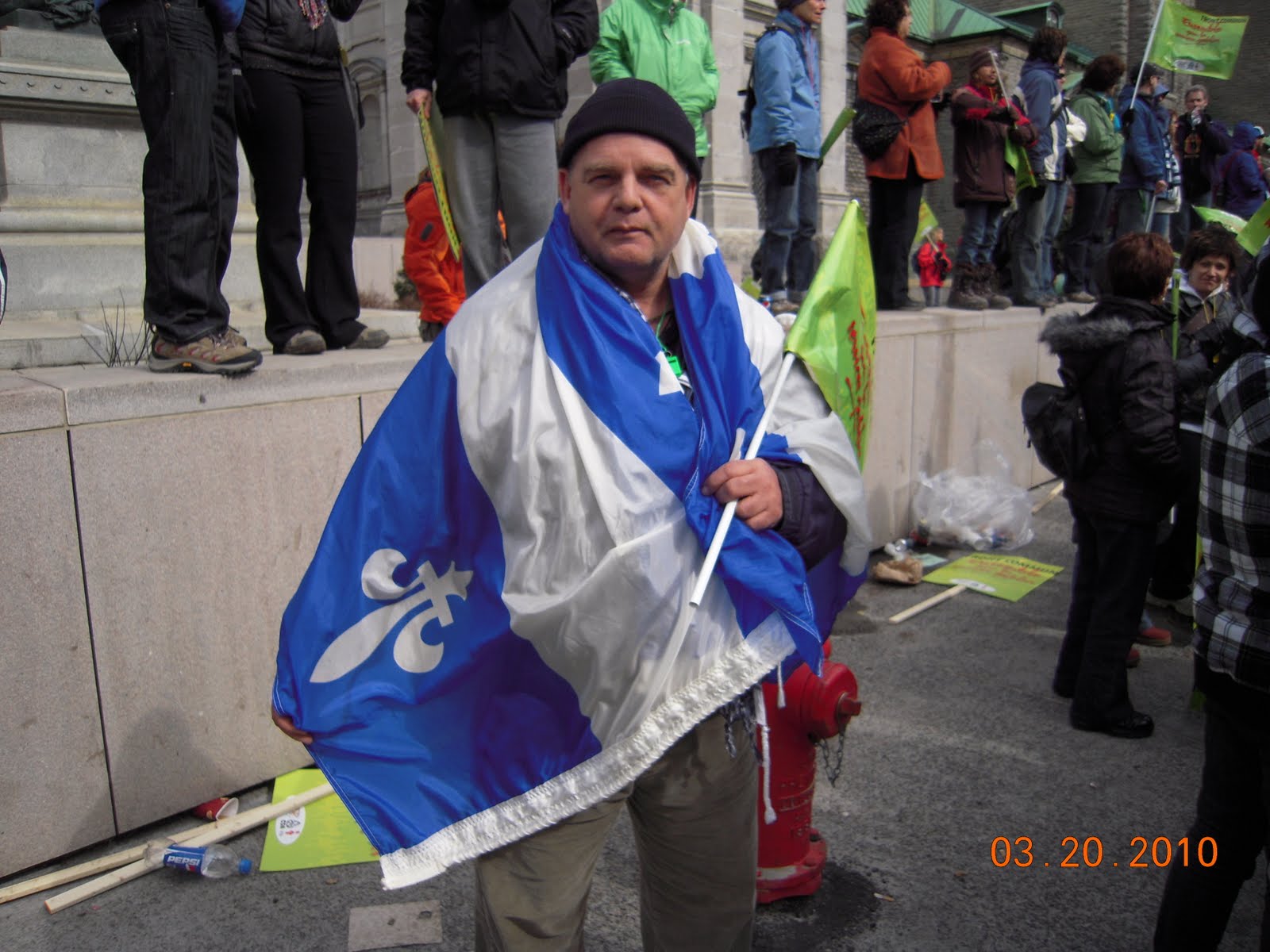
To force the provincial government to protect public services and negotiate in good faith with its 475 000 State employees, the trade union movement, people’s associations and Québec solidaire party organized a big demonstration in Montréal on March 20th, that drew over 75 000 workers (even construction workers attended). “Québec people want to preserve gains of the past, which they struggled for with sacrifices: such as access to quality public services”, according to a QS statement. The Party’s representative in the National Assembly, Amir Khadir, affirmed a few days beforehand that, “Banks, mining corporations, the ultra-wealthy must share the load”. Communist party of Québec members (PCQ) appeared at the demonstration with a new issue of their newspaper Clarté. The PCQ was well received and collected enough donations to pay half of the paper’s print run; it attracted many people, especially the locked-out employees of the daily newspaper Journal de Montréal.

The Research Institute in Contemporary Economy (l’Institut de recherche en économie contemporaine) charged that the government “must tax the wealthiest rather than raise the tariffs and allow the private sector to administer services”. They stressed that the “tax system must be revised and the contribution of the well-to-do and business should be increased.” Institute Director Robert Laplante questioned government spending billions of dollars in military expenditures while there are cutbacks in the health sector and increases in education fees.

Something noteworthy: Communists or would-be communists are more visible than ever even. Among them, the Communist Party of Canada (CPC) is the only progressive political party that has branches all over Canada and enjoys relations with Communist and worker’s parties across the world (including France and the USA). Today, there is a new generation of political and social activists ready to show that there must be “a life with a future for the youth”.
(Photo Marianne Breton-Fontaine: Québec communists denouncing IMF, WTO and WB during the demonstration).


* Pauline Marois leads the PQ. Severity is an euphemism when you deal with her leadership within her party and during her interventions in the National Assembly.

vendredi 19 février 2010

THIS CANADA

vol. 3, no. 3, MARCH 2010, $ 1.00


Foreword: many thanks to Tim Pelzer who edited this article, tpelzer@shaw.ca, please note that at the bottom you will find the link to an English selection of the french daily communist newspaper L'Humanité.


Si vous voulez lire en français: http://www.laviereelle.blogspot.com/

So many French-Canadians love Canada. In 1973 when I was 16 years old, I left Québec City on a beautiful July morning with two friends, Didier and Vincent, on a cycling trip to Toronto. We were proud and “endowed” with a mission: to convince English speaking Canadians that Québec should leave Canada. We were also intent on collecting further evidence proving that English speaking Canadians were out to destroy our nation and assimilate us into the melting pot of cultures. Didn’t we learn in secondary school that we could suffer from this disaster?

(Photo: always ready to move around to learn and share knowledge)

Once we arrived in Ontario, English speakers made us feel like kings. They treated us like famous athletes, offering free food and accommodation. They listened to us patiently when we spoke our broken English, making us feel like honoured guests.

People smiled at us and greeted us in a friendly manner. What an eye opening disappointment! What were we going to report to our friends back home about our journey to the “enemy’s kingdom”. In fact, we had nothing to complain... Besides, our parents were involved in the organization Expérience de vie internationale, (International Life Experience) to promote cultural exchanges with young people from USA. Now we were going to meet Québec’s real foes. Instead, these young people, especially those from New York taught us many interesting topics and introduced us to the music of Cat Stevens. It also happened - and we should not mention it too loudly- that we fell in love with the young beauties of our neighbouring country and learn to kiss for the first time.

Here again, we suffered a major setback in our endeavour to justify why Québec should separate from English speaking Canada.

The following year I went to Newfoundland. Instead of finding big mean English barbarians, I received a warm welcome. The people there were keen to know what Québec City looked like. They invited us to visit their houses, a wedding ceremony and an evening dance.

After a turbulent time in French speaking high school that led to my expulsion, my parents sent me to an English speaking high school, St.Patrick’s in Québec City to complete grade 12. During my year there I had a conflict with the “established gang”. One hot summer evening while savouring a beer in the Battlefields Federal Park, I met them by accident. We chatted and I told them that my presence in their High School had not been my choice and that I had been kicked out of French speaking school. They offered me a beer. Cheers they said happily. I became part of the gang.

In 1975, Québec students were engaged in a tight struggle with the government over the loan and bursary issue. Campus student organizations across the province were about to hold a meeting to create the National Association of Students (ANEQ). Speaking English, the Bishop University’s student delegation –consisting of three young women- invited me to be their translator at the upcoming meeting. A few months later I was elected to the national union’s Executive Council. I also joined the Young Communist League (YCL) of Canada. This was a turning point in my life. I agreed with the Communist party’s position on the place of Québec within confederation and its two-nation solution. I proposed this approach to the ANEQ and they adopted this position. At that time the union had 110,000 members and was very influential in Québec. The separatist Parti québécois members within the ANEQ were not happy.

(Photo: The Parti québécois members ultimately brought the cemetary peace within the Québec student movement in the 1980s)

ANEQ opened the horizons of Québec students after it invited the Prague based International Union of Students (IUS) to visit them in Québec City. The Association was also involved in the preparations for the World Youth and Students Festival that was going to take place in Habana, Cuba in the summer of 1978. The ANEQ spearheaded efforts to establish links with students in Ontario. Our motto was: Let’s get rid of this old story of two solitudes! We were young and wanted to create a new Canada. It was before the first separatist referendum in Québec. All over Canada, young communists were working for a new, modern and dynamic country.

But PQ members launched a counter attack and took over the ANEQ. At the 1978 ANEQ Convention, they elected their candidates to the executive, except for one position: information secretary which I occupied until my demotion. The PQ could not find anybody else to take the position. It was the beginning of the end for the YCL in Québec which lost most of its influence within the organization.

The YCL still exists but is in the process of rebuilding. By the way, All-Canada YCL general secretary Johan Boyden is going to marry Québec YCL leader Marianne Breton-Fontaine and they are expecting their first child in June 2010.

I spoke about my friends and me who in the early 1970s were trying to discover something that in reality did not exist. Contrary to what nationalists were and today are still claiming the French speaking nation of Québec is not facing the threat of disappearing. My childhood friend, Vincent Giguère, is now an international leader in the field of nuclear receptors, -a class of DNA-binding proteins that regulate the expression of genes-. He works very hard. In October 2009, McGill University proudly announced that this researcher has been elected as Fellow to the Royal Society of Canada, “in recognition of [his] outstanding scientific achievement”. Vincent is not a communist, but he is certainly a democrat like his family. He studied cloning in Great Britain in the 1980s. I could have spoken about medical doctor François Desbiens, or Michel Forget, who works closely with the leadership of the Confederation of National Trade Unions (CSN).

They all have been in a way or another involved in the student movement during the 1970s and helped foster understanding between French and English speaking students. The movement is certainly not dead.

I can say that they believe in democracy. They paved the way for their children to preserve what the past generations achieved. They are part of the new generation of French-Canadians who are open to other people and not intimidated by immigrants who want to learn the French language and enjoy Québec’s lively culture – i.e. jazz, music and comedy festivals and the like during the summer period.

(Photo: some delicatessen from Lebanon and Pakistan)


Modestly, many French Canadians would like other Canadians to know that in Québec, French Canadians are not all alike and that the future belongs to the working class and the progressive intellectuals and artists.


Vive le Canada populaire!
danieleugpaquet@yahoo.ca

L'Humanité in English


-30-

samedi 23 janvier 2010

OPEN LETTER TO LICIA CORBELLA

vol. 3, no. 2, February 2010, $ 1.00


si vous désirez lire en français: http://www.laviereelle.blogspot.com/


FOREWORD: Thanks to Tim Pelzer, tpelzer@shaw.ca who edited this letter.
__________________________


CALGARY HERALD (NEWSPAPER)


Dear colleague,


I recently had a glance at the Montréal Gazette. Your article "What if Quebecers got their wish and the oilsands closed?" caught my attention. I must admit that you have a humorous way of thinking and quick wits. However, I have to recognize that I was not aware about the topic and never realized that in Québec there was a desire to shut down the Alberta oilsands. Just recently I heard Gilles Duceppe affirming that it should be done.

(Photo Josette Thibault: Daniel Paquet, Editor La Vie Réelle in English)


I visited Calgary in 1977 -a beautiful city, by the way- so dreamy with the sight of the Rockies on its western horizons. The purpose was the annual convention of the National Union of Students (of English speaking Canada) - NUS which invited our Québec National Association of Students (ANEQ) to discuss on vital issues such as youth unemployment. First, NUS recognized the right of the French Canadian nation of Québec to self-determination up and including secession if the people choose; they also confirmed that ANEQ is an organization on an equal footing with NUS. This is what we expected to reshape Canada, to reinforce its unity.

I knew then that even the Parti québécois (PQ) members in our union, who were in the majority, would have to accept this gesture of solidarity, friendship and openness. It was one year after the election of the PQ in Québec and three years before the first referendum, in 1980.

I wanted to mention it to underline that in Québec, there is a battle of interests. This is what we call the class struggle. The PQ and its political ally the Bloc québécois represent nationalist petite bourgeoisie interests in Québec. These economic forces want Québec independence to control the State and expand their market share and profits within and without Québec.

The vast majority of the working people here do not support independence. In fact, many French Canadian workers are employed throughout Canada, including Alberta. The new party Québec solidaire is more inclined to defend the people's interests than the PQ and the Bloc, even though they also advocate Québec independence.

The only political party that is coherent on these matters (self-determination and oilsands) is the Communist Party which I doubt yo would support. Big business promotes their point of view through the mass media and encourages conflict and division between workers in English speaking Canada and Québec. I guess that you understand my point of view that there cannot be unity and prosperity in Canada without working class unity and economic independence, especially in regards to large US corporations such as the oil industry.

Rather than trying to describe fully what the essence of French Canadian pride is, I would like to invite you to Montréal, where I live, so you can get to know Québec and people better, including the arts and architecture, to name just a few areas where we have contributed to the general development of the Canadian culture. Your readers would love it.

I think that you will agree with me that we have, as journalists, the responsability to demonstrate to the Canadian people that they have much more in common that we can think.

I am confident that the future is not bad for Canada. I hope one day I will be able to write as well as you do in English. I hope that I will have the opportunity to prolong this conversation in the future.


Thank you sincerely!


Daniel Paquet

danieleugpaquet@yahoo.ca

L'Humanité in English


- 30 -