mercredi 24 mars 2010

THE DAM HAS BROKEN

FRENCH-CANADIANS WOKE UP WITH SPRING

vol. 3, no. 4, APRIL 2010, $ 1.00

Foreword: many thanks to Tim Pelzer, tpelzer@shaw.ca, who not only edits this column, but teaches English language to this author. Please note that at the bottom you will find the link to an English selection of the french daily communist newspaper L'Humanité, published in Paris.

Si vous voulez lire en français: http://www.laviereelle.blogspot.com/

Since the electoral defeat of the politically buoyant Parti Québécois (PQ) government, reactionary circles in Québec have placed their hopes on Jean Charest centrist Liberal Party to block left wing efforts to move Québec on to the road of social progress. It did work at the beginning. Now, after declining living standards for working families and constant increases in prices for goods and services such as electricity, Liberals are declining rapidly in popularity.
Neither did they halt public demands for political change in the status of Québec within Canadian confederation: the right to self-determination up and including separation if people choose.
Ironically, any proposal made as well to the PQ leadership and several of its militant members, even independence, does not seem acceptable to them, as long as they don’t lose their grip on the Québec society. It raises an important question. What is their secret agenda? Democracy, côté jardin, is it not madame Pauline Marois?*
(Photo: Arrival of demonstrators to the Montréal March).

Recently, the right –that did not put all its eggs in the same basket- received support from former PQ Premier Lucien Bouchard, who called for a hike in University tuitions for Québec students, according to the Montréal daily La Presse on February 24. Bouchard spoke on behalf of a group of “experts” at a press conference.
Two weeks later, the newspaper Métro reported that University students protested when Education Minister Michelle Courchesne, “hesitated’ about “how she would use the 35 M$ given as a supplement to Québec by Ottawa in the framework of the Canadian Program of Student Bursaries”. While students want to use this federal money to ameliorate the bursary’s system, the minister is not too clear yet. The Montréal Regional Coalition of Students, organized demonstrations and other actions, supported by the Montréal University Student Federation. Québec Young Communist League took part in the protests, according to provincial leader Marianne Breton-Fontaine in a phone interview with La Vie Réelle.
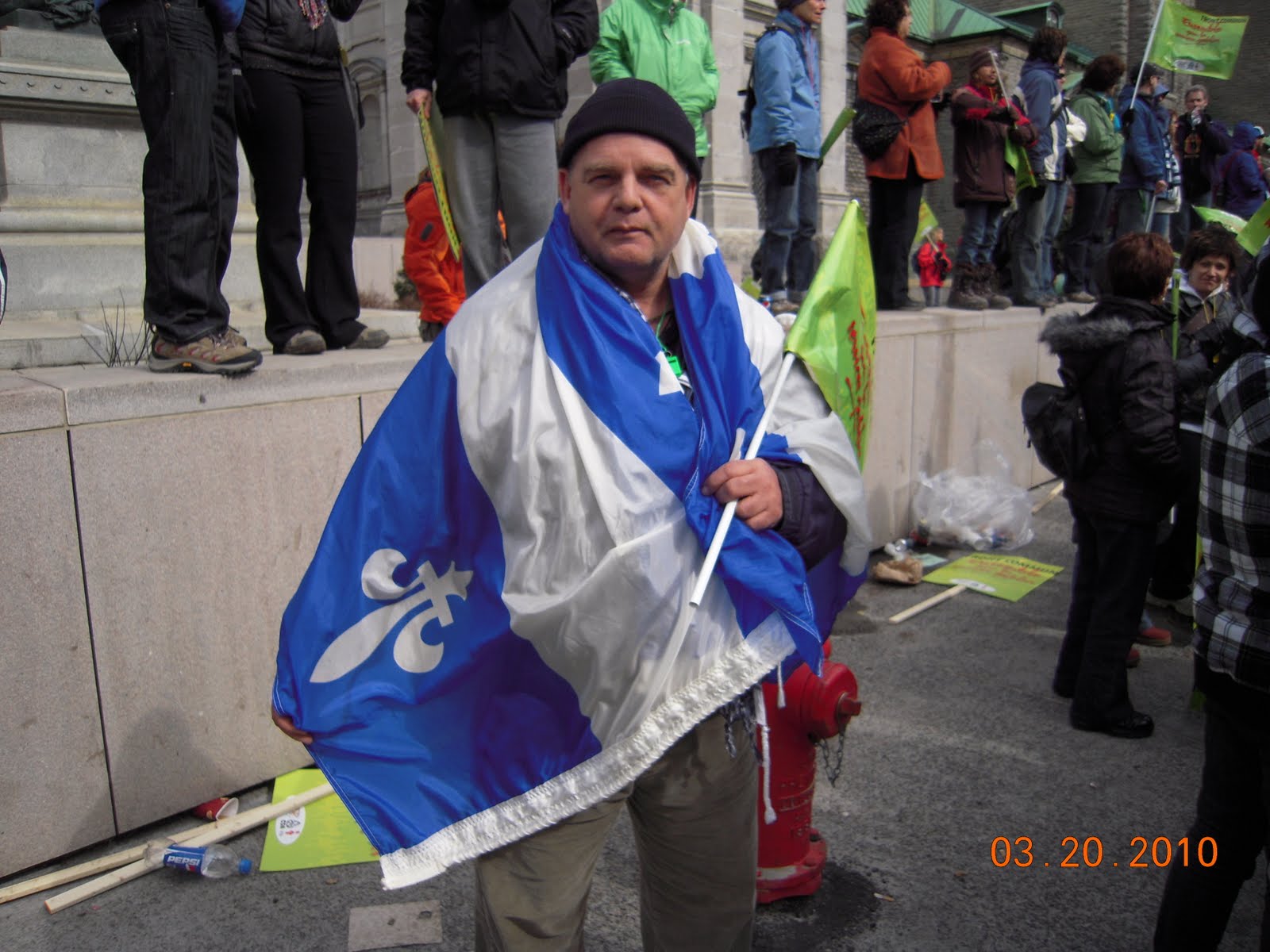
(Photo: several French-Canadian workers protest regularly against the constitutional status quo, denying their right to self-determination).

To force the provincial government to protect public services and negotiate in good faith with its 475 000 State employees, the trade union movement, people’s associations and Québec solidaire party organized a big demonstration in Montréal on March 20th, that drew over 75 000 workers (even construction workers attended). “Québec people want to preserve gains of the past, which they struggled for with sacrifices: such as access to quality public services”, according to a QS statement. The Party’s representative in the National Assembly, Amir Khadir, affirmed a few days beforehand that, “Banks, mining corporations, the ultra-wealthy must share the load”. Communist party of Québec members (PCQ) appeared at the demonstration with a new issue of their newspaper Clarté. The PCQ was well received and collected enough donations to pay half of the paper’s print run; it attracted many people, especially the locked-out employees of the daily newspaper Journal de Montréal.

The Research Institute in Contemporary Economy (l’Institut de recherche en économie contemporaine) charged that the government “must tax the wealthiest rather than raise the tariffs and allow the private sector to administer services”. They stressed that the “tax system must be revised and the contribution of the well-to-do and business should be increased.” Institute Director Robert Laplante questioned government spending billions of dollars in military expenditures while there are cutbacks in the health sector and increases in education fees.

Something noteworthy: Communists or would-be communists are more visible than ever even. Among them, the Communist Party of Canada (CPC) is the only progressive political party that has branches all over Canada and enjoys relations with Communist and worker’s parties across the world (including France and the USA). Today, there is a new generation of political and social activists ready to show that there must be “a life with a future for the youth”.
(Photo Marianne Breton-Fontaine: Québec communists denouncing IMF, WTO and WB during the demonstration).


* Pauline Marois leads the PQ. Severity is an euphemism when you deal with her leadership within her party and during her interventions in the National Assembly.

vendredi 19 février 2010

THIS CANADA

vol. 3, no. 3, MARCH 2010, $ 1.00


Foreword: many thanks to Tim Pelzer who edited this article, tpelzer@shaw.ca, please note that at the bottom you will find the link to an English selection of the french daily communist newspaper L'Humanité.


Si vous voulez lire en français: http://www.laviereelle.blogspot.com/

So many French-Canadians love Canada. In 1973 when I was 16 years old, I left Québec City on a beautiful July morning with two friends, Didier and Vincent, on a cycling trip to Toronto. We were proud and “endowed” with a mission: to convince English speaking Canadians that Québec should leave Canada. We were also intent on collecting further evidence proving that English speaking Canadians were out to destroy our nation and assimilate us into the melting pot of cultures. Didn’t we learn in secondary school that we could suffer from this disaster?

(Photo: always ready to move around to learn and share knowledge)

Once we arrived in Ontario, English speakers made us feel like kings. They treated us like famous athletes, offering free food and accommodation. They listened to us patiently when we spoke our broken English, making us feel like honoured guests.

People smiled at us and greeted us in a friendly manner. What an eye opening disappointment! What were we going to report to our friends back home about our journey to the “enemy’s kingdom”. In fact, we had nothing to complain... Besides, our parents were involved in the organization Expérience de vie internationale, (International Life Experience) to promote cultural exchanges with young people from USA. Now we were going to meet Québec’s real foes. Instead, these young people, especially those from New York taught us many interesting topics and introduced us to the music of Cat Stevens. It also happened - and we should not mention it too loudly- that we fell in love with the young beauties of our neighbouring country and learn to kiss for the first time.

Here again, we suffered a major setback in our endeavour to justify why Québec should separate from English speaking Canada.

The following year I went to Newfoundland. Instead of finding big mean English barbarians, I received a warm welcome. The people there were keen to know what Québec City looked like. They invited us to visit their houses, a wedding ceremony and an evening dance.

After a turbulent time in French speaking high school that led to my expulsion, my parents sent me to an English speaking high school, St.Patrick’s in Québec City to complete grade 12. During my year there I had a conflict with the “established gang”. One hot summer evening while savouring a beer in the Battlefields Federal Park, I met them by accident. We chatted and I told them that my presence in their High School had not been my choice and that I had been kicked out of French speaking school. They offered me a beer. Cheers they said happily. I became part of the gang.

In 1975, Québec students were engaged in a tight struggle with the government over the loan and bursary issue. Campus student organizations across the province were about to hold a meeting to create the National Association of Students (ANEQ). Speaking English, the Bishop University’s student delegation –consisting of three young women- invited me to be their translator at the upcoming meeting. A few months later I was elected to the national union’s Executive Council. I also joined the Young Communist League (YCL) of Canada. This was a turning point in my life. I agreed with the Communist party’s position on the place of Québec within confederation and its two-nation solution. I proposed this approach to the ANEQ and they adopted this position. At that time the union had 110,000 members and was very influential in Québec. The separatist Parti québécois members within the ANEQ were not happy.

(Photo: The Parti québécois members ultimately brought the cemetary peace within the Québec student movement in the 1980s)

ANEQ opened the horizons of Québec students after it invited the Prague based International Union of Students (IUS) to visit them in Québec City. The Association was also involved in the preparations for the World Youth and Students Festival that was going to take place in Habana, Cuba in the summer of 1978. The ANEQ spearheaded efforts to establish links with students in Ontario. Our motto was: Let’s get rid of this old story of two solitudes! We were young and wanted to create a new Canada. It was before the first separatist referendum in Québec. All over Canada, young communists were working for a new, modern and dynamic country.

But PQ members launched a counter attack and took over the ANEQ. At the 1978 ANEQ Convention, they elected their candidates to the executive, except for one position: information secretary which I occupied until my demotion. The PQ could not find anybody else to take the position. It was the beginning of the end for the YCL in Québec which lost most of its influence within the organization.

The YCL still exists but is in the process of rebuilding. By the way, All-Canada YCL general secretary Johan Boyden is going to marry Québec YCL leader Marianne Breton-Fontaine and they are expecting their first child in June 2010.

I spoke about my friends and me who in the early 1970s were trying to discover something that in reality did not exist. Contrary to what nationalists were and today are still claiming the French speaking nation of Québec is not facing the threat of disappearing. My childhood friend, Vincent Giguère, is now an international leader in the field of nuclear receptors, -a class of DNA-binding proteins that regulate the expression of genes-. He works very hard. In October 2009, McGill University proudly announced that this researcher has been elected as Fellow to the Royal Society of Canada, “in recognition of [his] outstanding scientific achievement”. Vincent is not a communist, but he is certainly a democrat like his family. He studied cloning in Great Britain in the 1980s. I could have spoken about medical doctor François Desbiens, or Michel Forget, who works closely with the leadership of the Confederation of National Trade Unions (CSN).

They all have been in a way or another involved in the student movement during the 1970s and helped foster understanding between French and English speaking students. The movement is certainly not dead.

I can say that they believe in democracy. They paved the way for their children to preserve what the past generations achieved. They are part of the new generation of French-Canadians who are open to other people and not intimidated by immigrants who want to learn the French language and enjoy Québec’s lively culture – i.e. jazz, music and comedy festivals and the like during the summer period.

(Photo: some delicatessen from Lebanon and Pakistan)


Modestly, many French Canadians would like other Canadians to know that in Québec, French Canadians are not all alike and that the future belongs to the working class and the progressive intellectuals and artists.


Vive le Canada populaire!
danieleugpaquet@yahoo.ca

L'Humanité in English


-30-

samedi 23 janvier 2010

OPEN LETTER TO LICIA CORBELLA

vol. 3, no. 2, February 2010, $ 1.00


si vous désirez lire en français: http://www.laviereelle.blogspot.com/


FOREWORD: Thanks to Tim Pelzer, tpelzer@shaw.ca who edited this letter.
__________________________


CALGARY HERALD (NEWSPAPER)


Dear colleague,


I recently had a glance at the Montréal Gazette. Your article "What if Quebecers got their wish and the oilsands closed?" caught my attention. I must admit that you have a humorous way of thinking and quick wits. However, I have to recognize that I was not aware about the topic and never realized that in Québec there was a desire to shut down the Alberta oilsands. Just recently I heard Gilles Duceppe affirming that it should be done.

(Photo Josette Thibault: Daniel Paquet, Editor La Vie Réelle in English)


I visited Calgary in 1977 -a beautiful city, by the way- so dreamy with the sight of the Rockies on its western horizons. The purpose was the annual convention of the National Union of Students (of English speaking Canada) - NUS which invited our Québec National Association of Students (ANEQ) to discuss on vital issues such as youth unemployment. First, NUS recognized the right of the French Canadian nation of Québec to self-determination up and including secession if the people choose; they also confirmed that ANEQ is an organization on an equal footing with NUS. This is what we expected to reshape Canada, to reinforce its unity.

I knew then that even the Parti québécois (PQ) members in our union, who were in the majority, would have to accept this gesture of solidarity, friendship and openness. It was one year after the election of the PQ in Québec and three years before the first referendum, in 1980.

I wanted to mention it to underline that in Québec, there is a battle of interests. This is what we call the class struggle. The PQ and its political ally the Bloc québécois represent nationalist petite bourgeoisie interests in Québec. These economic forces want Québec independence to control the State and expand their market share and profits within and without Québec.

The vast majority of the working people here do not support independence. In fact, many French Canadian workers are employed throughout Canada, including Alberta. The new party Québec solidaire is more inclined to defend the people's interests than the PQ and the Bloc, even though they also advocate Québec independence.

The only political party that is coherent on these matters (self-determination and oilsands) is the Communist Party which I doubt yo would support. Big business promotes their point of view through the mass media and encourages conflict and division between workers in English speaking Canada and Québec. I guess that you understand my point of view that there cannot be unity and prosperity in Canada without working class unity and economic independence, especially in regards to large US corporations such as the oil industry.

Rather than trying to describe fully what the essence of French Canadian pride is, I would like to invite you to Montréal, where I live, so you can get to know Québec and people better, including the arts and architecture, to name just a few areas where we have contributed to the general development of the Canadian culture. Your readers would love it.

I think that you will agree with me that we have, as journalists, the responsability to demonstrate to the Canadian people that they have much more in common that we can think.

I am confident that the future is not bad for Canada. I hope one day I will be able to write as well as you do in English. I hope that I will have the opportunity to prolong this conversation in the future.


Thank you sincerely!


Daniel Paquet

danieleugpaquet@yahoo.ca

L'Humanité in English


- 30 -

jeudi 31 décembre 2009

THE 36TH CENTRAL CONVENTION IN TORONTO


JUST BEFORE, A LITTLE TALK ABOUT THE ENVIRONMENT

vol. 3, no. 1, January 2010, $ 1.00


si vous voulez lire en français, : http://www.laviereelle.blogspot.com/


FOREWORD: Many thanks to Tim Pelzer, tpelzer@shaw.ca who edited this article. Don't forget the link below to L'Humanité in English, selection of the daily communist newspaper published in Paris.

But why did they organize it so far away? After all, Copenhagen is not a suburb of Montréal. In November, Prime Minister Stephen Harper declared in Singapore in relation with this meeting: “Everybody is looking for a convenient agreement that will not impose upon us a burden too heavy, that is the reason why negotiations are so difficult”. The conservative newspaper The Gazette chose to write in December that “oil and gas producers comprised the largest industry lobbying group from January through August 2009 with 24 companies and associations represented in Ottawa, according to the registry. These include all the major oil companies.” One of the lobbyists was Ken Boessenkooll, “a campaign adviser and a senior policy adviser to Harper when he was leader of the opposition.” Maybe it smells of oil, but it does not smell good at any rate... (Photo SolidNet: Anti-imperialist demonstration in Athens, 2009)


The French communist philosopher, Georges Gastaud, wrote recently on the topic and said: “If any “cut” ecological movement takes us away from anti-capitalistic class struggle, a responsible ecological and comprehensive implication carries us, on the contrary, to get involved now and not before another century in a new society free from capitalist depredations and class, without havoc by a handful of irresponsible elements looking for profits. We need a society supporting revolution in the world of science, of political power and relations of properties. We must collectivize for the benefit of everybody, knowledge and human products. In a nutshell, we call for a communist society.”


Sadly enough, the Chinese Communist Party delegation at the last International Meeting of Communist and Workers ‘Parties in New Delhi, India, concluded that: “no social order ever disappears before all the productive forces, for which there is room in it, have been developed; and new higher relation of production never appear before the material conditions of their existence have matured in the womb of the old society”. Thus “capitalism will remain more powerful than socialism for a certain period to come...” During the same meeting, the Vietnam delegation affirmed that their next convention will “map out the socio-economic development strategy for the next 10 years (2011-2020) with the targets of becoming a modern-industrial country by 2020 and strongly progressing to socialism in which people are wealthy; country is strong; society is equal, democratic and civilized.”


THE CANADIAN CONVENTION


From February 5th to 7th, delegates from all parts of Canada will gather in Toronto to attend the Central Convention of the Communist Party of Canada (CPC). As a backdrop, we can mention the struggles of the employees and journalists of Le journal de Montréal who are still locked out after almost one year. In November, elected Québec Solidaire member Amir Khadir introduced a motion in the Quebec National Assembly inviting both parties to negotiate so that “the rights of the workers be respected...” It was adopted unanimously. In October, Khadir, declared to Le Devoir, in relation with the situation in the construction industry, that, “I believe seriously enough that the Liberal Party of Québec could be sullied...” in an eventual public inquiry in this area.
(Photo SolidNet: Demonstration in Paraguay in support of democracy, 2009)

In October, Le Devoir reported that some Québec farmers were dissatisfied with their organization the Union of Farm Growers (Union des producteurs agricoles-UPA), established in 1972. The discontented members were not clear about whether they wanted to leave the UPA, only stating that “they want something else”.

During the CPC convention, discussions will take place on the role of the Party in relation with the people’s struggles. Another question being discussed is the Marxist concept of the dictatorship of the proletariat. Rebel Youth editor (magazine of the Young Communist League of Canada), Stephen Von Sychowski wrote: “When we talk about what people think of that particular theoretical aspect of Marxism-Leninism we are dealing with a relatively small segment of the people who are the more educated [...]. The reality is that most of people’s knowledge of revolutionary theory is based on anti-communist propaganda and a few tidbits of often questionable historical information.” (Discussion Bulletin, November 4th, 2009, no.2, p. 6).
La Vie Réelle in English shares the CPC´s point of view that the working class of Canada will have to exercise political power and defend any revolutionary measures once they win power. The political party of the workers will also have to raise the question of the toiling people in all regions. For instance before New Year 2010, AbitibiBowater, a US-based multinationals shuts down its operations in Beaupré and Clermont, near Québec City, dismissing hundreds of employees. The company also closed plants in Ontario, Nova Scotia and Alabama, according to Quebec City´s daily Le Soleil.

Speaking of Québec, the Communist Party shall reiterate its position for a new Canada where the two founding nations, Québec and English speaking Canada, will be equal and united, and Québec will enjoy the right to secession. It is the right moment since the Parti québécois (PQ) is trying again to mobilize the population to separate from Canada, taking advantage of anti-English sentiment caused by dissatisfaction with the federal conservative government.
(Photo SolidNet: Demonstration in Italy for the freedom of information, in 2009)

L'Humanité in English


-30-

mardi 15 décembre 2009

HAPPY NEW YEAR 2010!

si vous voulez lire en français, : http://www.laviereelle.blogspot.com/


On the occasion of the New Year 2010, La Vie Réelle in English wishes to all its readers Peace, Progress and Prosperity.


We wish you as well Health and Wellbeing.


We hope in a new Canada, a land of democracy and freedom for all, where French-Canadians and English-speaking Canadians will live in equality, with the right of Québec to self-determination as a nation, up and including secession if this is the will of the people; alongside with the rights of the First Nations and the immigrant communities.


We extend warm salutations to the Communist Party of Canada which will hold its 36th Central Convention in Toronto (Ontario), not so far away from Guelph where it was founded in 1921 by a group of some 20 people that garner rapidly the support of thousands of workers in our country for the right to a decent housing, job and more generally a Life with a Future, a socialist Canada.
(Photo: Daniel Paquet, editor; with a group of young french communists in Paris, Spring 2009)

We extend fraternal greetings to the International Communist Review published in Athens (Greece) by a collective of theoretical communist journals from all around the world, including Debate Abierto from the Communist party of Venezuela, in our hemisphere.


Finally, we salute the Canadian delegation to the Winter Olympic Games in Vancouver and wish them successes in the coming competitions.


Montréal, December 2009

- 30 -

lundi 23 novembre 2009

FRENCH-CANADIANS AND IMMIGRANTS

THE GENTLEMAN'S AGREEMENT

vol. 2, no.10, December 2009, $ 1.00
si vous voulez lire en français, : http://www.laviereelle.blogspot.com/

FOREWORD: Many thanks to Tim Pelzer, tpelzer@shaw.ca who edited this article. Don't forget the link below to L'Humanité in English, selection of the daily communist newspaper published in Paris.
___________________________________


Daniel Paquet*

Who knows? Maybe the book recently published by former Québec Premier Jacques Parizeau is going to crash.

At the moment the Parti Québécois (PQ) is trying by any means to kindle the light of separatism. The left leaning party Québec solidaire is also expecting to attract the nationalist vote, especially youth who reject the PQ’s conservative orientation. Actually, it looks like a child’s game of musical chairs: the music plays and when it stops, you better find a chair; otherwise you will be expelled from the game.

The PQ is the official opposition party in the National Assembly and plays on the federal government’s failure to recognize Québec’s French Canadian nation. Of course, the Stephen Harper conservative party recognized Québec as nation. But, in practice, it is like affirming officially and strongly that Toronto is in Ontario!

PQ leaders take profit from the French Canadian people’s dissatisfaction with the status quo. They believe that – especially in some parts of Montréal- you have to speak English in commercial outlets and restaurants now. This is partly true. But it is not a deliberate campaign by small business owners as they don’t feel that they are going to increase their customer base by recruiting more French speaking personnel. Nevertheless, French Canadians, especially the young, feel hurt by this. Their reaction is understandable, though exaggerated.
(Photo: once attended the catholic churches are now deserted by the French-Canadians)


The Communist Party of Canada (CPC) speaks the language of wisdom and democracy. They advocate recognizing the right of the French Canadian to self-determination up and including secession from Canada. They oppose, naturally, discrimination against French Canadians in La Belle Province wherever they work and live. Of course, they don’t believe immigrants and English Canadians should be forced to speak French but instead encouraged to learn and use the language.

It is obvious that in the future, the French Canadians will have to learn English, but it must not be mandatory. They must be encouraged to do it gradually without loosing the French language. Anyhow, today it is common for immigrant children to speak French and English as well as their parent’s language (Spanish, Arabic or Urdu).

In the past, the Communists associated themselves regularly with the PQ members on various issues, like peace campaigns, solidarity with the Chilean people or the defence of Cuba. Many PQ members are progressive, but they are fiercely obtuse on the national question. It is almost a psychological barrier. PQ members are active in people’s associations, unions and movements and they outnumber communist Party members in these movements. During elections they win easily. One must not make mistakes: the PQ is not like the New Democratic Party, a socialist party or a social-democrat party. Instead it is a coalition party with a left wing.
(Photo: big canadian companies benefit from the absence of a mass communist party in Canada)


However, the CPC has influence in the trade-unions. One of the Party’s mistakes during the 1990s was to recruit former nationalists to its ranks, nearly destroying the Party. The revolutionary “pessimism” was caused by the Soviet Union’s disappearance added to the Party’s near downfall. The communist movement in Québec overcame this mistake and is ready to form alliances with the PQ members but on an equal footing. Furthermore, the centrist Liberal Party led by Jean Charest adopts policies that are fair for the people, even though the PQ waits like a vulture to diminish the Liberals in the public eye.

Finally, the PQ has no newspaper in Québec like for instance the French Communist Party daily newspaper l’Humanité. Our readers should know that many journalists from the written and electronic press have attended courses at Montréal’s Québec University under the direction of the late professor Pierre Bourgault, former leader of the nationalist Rassemblement pour l’Indépendance Nationale (Rally for the National Independence –RIN). Bourgault liked to ridicule Greek, Italian and Jews, while he was smoking his eternal Gitanes at his classroom’s entrance. Of course, he could not ignore the progressive and dynamic role played by representatives of theses communities in the development of the communist movement in Montréal.
(Photo SolidNet: communist meeting in Greece)

The French Canadians workers realize now that you can deal about bread and butter and still ask for a Québec traditional product. Finally, one should be aware that communists are developing the embryo of a mass organization in Montréal’s eastend. One day, the French CBC anchorman, at an electoral soirée will announce that “if the trend keeps on going, the next government will be formed by the communist party…”


L'Humanité in English
______________


* (Daniel Paquet studied Communications at Montréal’s Québec University from 1993 to 1996, where he graduated in journalism with honours)


- 30 -

mercredi 4 novembre 2009

ABOUT TRUTH AND VICTORY


vol. 2, no. 9, November 2009, $ 1.00

si vous voulez lire en français, : http://www.laviereelle.blogspot.com/

FOREWORD: Many thanks to Tim Pelzer, tpelzer@shaw.ca who edited this article. Don't forget the link below to L'Humanité in English, selection of the daily communist newspaper published in Paris.
______________________________

It’s all started with the last column that I wrote. My dear friend and editor, Tim, said to me: “Sometimes you can be overly abstract and theoretical to the point that I have trouble understanding what you are saying […] if I have trouble understanding what you are saying, I am sure that your readers will have the same problem.”

I read over the whole article. Tim is right. But why publish a newsletter in English if one cannot express himself properly? The reason is very basic: I am totally devoted to the Québec people and I want English speaking Canadians - and others - to know that we are not a bunch of angry, restless separatists, waiting for the next referendum to drag us out of Canada. Naturally, since this column is read by intellectuals and journalists, I did not want to give them the impression that La Vie Réelle in English was a simple read that could be labelled as a cheap piece of French Canadian communist writing. (Photo: a typical French-Canadian homestead in Québec City)

But Tim, very generously, added: “You can express yourself well in English. I know this because of our wonderful email conversations. Write as if you are writing your readers an email. Write in simple prose that is easy to grasp. This is important if you want to appeal to working class readers.” Not only was I touched, but it brought two things to mind: first that we have to persuade people in Québec that it is important to learn English and second it is important to learn the history of English speaking Canada. Even communists around the world have adopted English in their communications. For instance, SolidNet, the Communist and Worker's Parties central communication's bureau in Athens, Greece distributes documents and bulletins in Spanish, Italian, Russian, Portuguese and English. Few documents are in French. I believe that when the French communist party becomes more involved in world solidarity movements there will be more French publications. At the moment, even Québec communists use English to communicate with central party headquarters in Toronto.

Of course, main documents are translated from English to French. Those living in Vancouver, Halifax or Hamilton should know that there is a lively, flourishing French speaking culture in Québec. We have prominent and talented singers like Robert Charlesbois (Ordinaire) as well as new ones like Lynda Thalie (Une femme amoureuse), an immigrant from the Arab world. Well, the point is that we don’t eat pea soup, cretons and pâté chinois like in the past. We have changed. We go for sushi, couscous and souvlaki now. And there are even some who believe that God does not oppose French Canadians joining the communist party. C’est la vie… (Photo : a Montréal-born new Québécoise, Nile)

Even in the labour movement there are changes. For instance the Québec Centre of Trade Unions, formerly the Québec Teacher's Union, decided at its last convention in June 2009 to get involved in politics “so that we live in the type of society that we want to build”. We increased our solidarity with workers from other parts of the world. For instance, the Québec Federation of Labour (500 000 members) opposes the Free Trade Agreement that the Canadian government signed with Colombia because of the systematic violations of human rights in that country. The Union Centre invites its “member unions and regional councils to put pressure on conservative and liberal MPs…” And, the Confederation of National Trade Unions (300 000 members) will enlarge its support policy for striking workers. Recently, union members working at Le Journal de Québec decided to “give 1% of their salaries to the union representing 253 workers at Le Journal de Montréal”, who have been on lock-out for over 8 months.

Karl Marx in the article published under the title of Communism and the Augsburg Allgemeine Zeitung, concluded that: “ We are firmly convinced that the real danger lies not in practical attempts, but in the theoretical elaboration of communist ideas, for practical attempts, even mass attempts, can be answered by cannon as soon as they become dangerous, whereas ideas, which have conquered our intellect and taken possession of our minds, ideas to which reason has fettered our conscience, are chains from which one cannot free oneself without a broken heart…” (Collected Works, Vol. 1, International Publishers, New York, 1985, pp. 220-221)

As readers know, there is an older bulletin named La Vie Réelle (just in french). One of its readers wrote not long ago: “A very good issue. One reads it and can make up one’s own opinion. Articles are never aggressive, I appreciate it.” (Photo: a renovated catholic church in Québec City)


- 30 -